Best Solar Generators for RVs (2026): Jackery vs. EcoFlow
Two brands dominate the RV solar generator market. We compare them side by side — capacity, output, price, and which one is right for your camping style.
Updated April 2026 · Check Amazon for current prices
Affiliate Disclosure: RVGearZone earns a small commission on Amazon purchases at no extra cost to you. Prices shown as typical ranges — check Amazon for the current price.
A solar generator — also called a portable power station — is a rechargeable battery unit with AC outlets, USB ports, and DC outputs built in. Unlike a gas generator, it's completely silent, produces zero fumes, and is allowed at virtually every campsite that bans generators after quiet hours.
For RVers, the use cases are straightforward: keep your CPAP running overnight without shore power, run a fan or mini-fridge at a dry campsite, charge phones and laptops, and power small appliances. Pair one with a portable solar panel and you can go days — or indefinitely — without a hookup or generator.
Silent operation — no engine noise, no exhaust, neighbor-friendly
No fuel to store or spill — charge at home or via solar panels on the road
Campsite-legal — works during generator quiet hours
CPAP-friendly — most models run a CPAP for 8–20+ hours per charge
Pairs with solar — recharge for free using Jackery or EcoFlow solar panels
How Much Capacity Do You Actually Need?
Watt-hours (Wh) is the key number. It tells you how much total energy a power station holds. A higher number means more runtime — but also more weight and cost. Here's a practical guide for RVers:
🔋
200–300Wh
Light Use
Phones, tablets, LED lights, small fans, camera batteries. Good for weekend car campers or as a backup power source. 1–2 nights of basic device charging.
⚡
500–1100Wh
Sweet Spot
CPAP (no humidifier), mini-fridge (short runs), laptop, fan, lights, multiple devices. Covers most weekend RVers. 2–4 nights of real use without recharging.
🏕️
1500Wh+
Full-Time Boondocking
CPAP with humidifier, 12V fridge (extended runs), multiple devices, small appliances. Built for full-time boondockers or extended off-grid stays. 4+ days with solar.
⚠️ Real-world output is typically 80–90% of rated capacity.
Battery chemistry, temperature, and discharge rate all reduce effective capacity. A 1000Wh unit will realistically deliver around 850–900Wh under normal conditions. Factor this in when sizing your purchase.
🔬 EcoFlow X-Boost — What It Is and Why It Matters
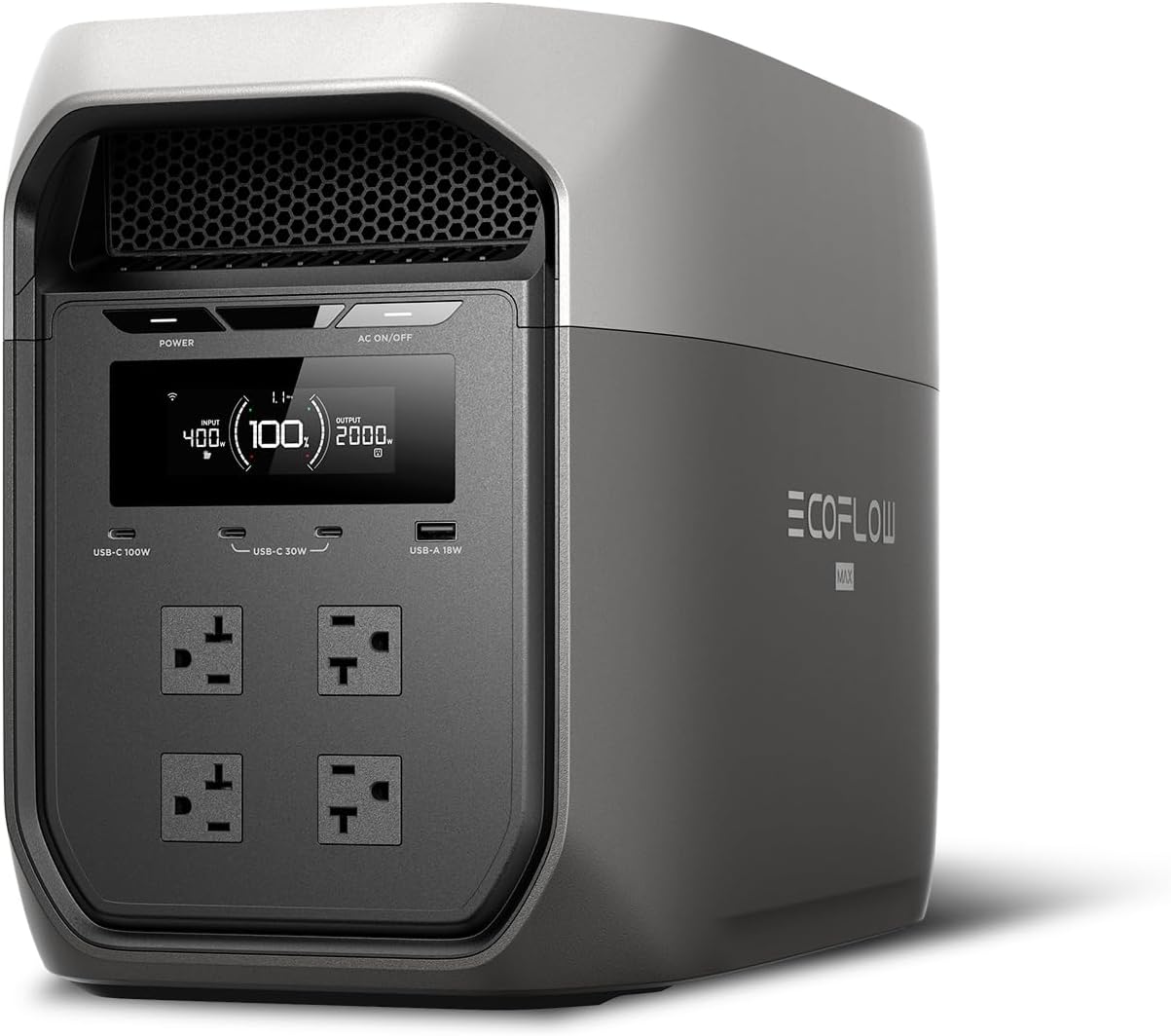
EcoFlow's X-Boost technology allows their power stations to run appliances rated at up to twice the unit's AC output. A River 2 Pro rated at 800W AC can power devices up to 1600W using X-Boost — the station monitors the appliance's actual draw and manages power delivery intelligently. Jackery has no equivalent technology. This is EcoFlow's single biggest competitive advantage, and it's a real differentiator if you want to run a hair dryer, electric kettle, or small microwave from a mid-range unit.
Mid-Range Head-to-Head: Spec-for-Spec
The Jackery Explorer 1000 v2 and EcoFlow River 2 Pro are the most direct mid-range competitors — similar budgets, very different strengths. Orange ★ marks the leader in each category.
Both brands make excellent power stations. Here's how they compare at the brand level — the differences that matter regardless of which model you pick:
Feature
Jackery
EcoFlow
Battery Chemistry
LiFePO4
LiFePO4
Power Boost Technology
✗ None
✓ X-Boost (2× output)
Fast Charging (~1hr)
✓ (1000 v2 and up)
✓ Across full lineup
App Control
✓ Jackery App
✓ EcoFlow App
Expandable Capacity
✗ No
✓ Yes (Delta series)
Warranty
3 years
5 years
Solar Panel Ecosystem
✓ Jackery Solar Panels
✓ EcoFlow Solar Panels
Best Entry Price
$150–$200 (Explorer 300)
$150–$200 (River 3)
Brand Strength
Pioneer, most-trusted
Fastest-growing, most innovative
💡 Pricing Insight
At the entry level, prices are nearly identical (both in the $150–$200 range). The mid-range is where it gets interesting: Jackery's 1000 v2 gives you more raw capacity (1070Wh vs 768Wh) for about $70 more than the EcoFlow River 2 Pro — but EcoFlow's X-Boost makes the River 2 Pro capable of running significantly larger appliances. At the high end, both brands land in the $750–$800 range and offer nearly identical capacity (~2040Wh). The EcoFlow Delta 3 Max edges ahead with 3400W X-Boost output vs Jackery's 2200W rated output.
Jackery invented the portable solar generator category and remains the most trusted name in the space. Their Explorer lineup covers every use case from a compact weekend unit to a serious boondocking powerhouse, and their reliability record over a decade on the market is hard to argue with. The Explorer 1000 v2 in particular has become the go-to recommendation for most RV owners — 1070Wh of LiFePO4 capacity, 1500W AC output, and a 1-hour fast charge via wall outlet.
The v2 generation was a significant upgrade over the original Explorer line. LiFePO4 chemistry replaced the older lithium-ion cells, extending the cycle life from ~500 to 4000+ cycles. That means if you charge it once a day, the battery should still hold 80% of its capacity in over a decade. The build quality is excellent — solid, well-finished, with a clear LCD display and intuitive button layout that doesn't require reading a manual.
The honest limitation is the lack of X-Boost or any equivalent power management feature. A Jackery rated at 1500W AC handles loads up to 1500W — period. If you want to run a 1200W hair dryer, you need a unit rated for it. EcoFlow's mid-range units can punch above their rated output; Jackery's cannot. For most RVers this doesn't matter, but it's worth knowing.
EcoFlow is the most innovative brand in the portable power space, and their product lineup has significantly closed the gap on Jackery's reliability lead over the past two years. What sets EcoFlow apart is X-Boost — their proprietary power management system that allows mid-range units to run appliances rated at twice their AC output. The River 2 Pro, rated at 800W AC, can run devices up to 1600W with X-Boost active. For RVers who want to run a hair dryer, electric kettle, or small microwave without buying a 2000Wh unit, this is a genuine game-changer.
The River 3, in the $150–$200 range, is EcoFlow's entry-level unit and one of the best values in portable power. It fast-charges in about 1 hour from a wall outlet — something Jackery's entry-level 300 cannot match — and its 245Wh capacity is enough for a night of phone/laptop charging, LED lighting, and a CPAP without a humidifier. The app is genuinely useful, showing real-time power in/out and battery status at a glance.
EcoFlow's 5-year warranty beats Jackery's 3-year coverage, and their expandable capacity system (available on the Delta series) means you can add a compatible extra battery pack later if your needs grow. The main trade-off is brand maturity — Jackery has a longer track record, and their community support (forums, YouTube tutorials, compatibility guides) is deeper than EcoFlow's at this point.
Both Jackery and EcoFlow make excellent solar generators. The right choice comes down to what you value most:
🏆 Choose Jackery if...
You want the most trusted name in the space, the simplest operation, and long-term reliability with deep community support. The Explorer 1000 v2 is the best all-around RV power station on the market at its price point — and if you want a unit that "just works" without learning any features or dealing with app quirks, Jackery is the safer pick.
You want maximum value and flexibility. X-Boost lets you run bigger appliances from a smaller, cheaper unit. The 5-year warranty beats Jackery's 3-year coverage. And if there's any chance you'll want to expand capacity later, EcoFlow's Delta series lets you add a battery pack — Jackery can't do that. The River 3 is the best entry-level power station at any price.
What's the difference between a "solar generator" and a "power station"?
They're the same thing — the terms are used interchangeably. "Solar generator" just emphasizes that the unit can be recharged via solar panels. Both Jackery and EcoFlow sell their units as power stations that are solar-compatible. Neither brand includes solar panels in the box for the standard models — those are purchased separately.
Can I run my CPAP machine from a portable power station?
Yes — this is one of the most common RV use cases. A CPAP without a humidifier typically draws 30–60W. A 1000Wh unit will run it for roughly 15–30 hours per charge. With a humidifier active, draw increases to 100–200W, cutting runtime to 5–10 hours. Most users run CPAP without the humidifier when on battery power. Note that EcoFlow's X-Boost can improve compatibility with some CPAP models that draw above the unit's rated AC output.
How do I charge a solar generator at a campsite?
Three main options: (1) Wall outlet — fastest, typically 1–3 hours depending on model. (2) Solar panels — chain Jackery or EcoFlow panels to the unit's solar input port; recharge time depends on panel wattage and sun conditions, typically 4–10 hours with a 200W panel. (3) Car 12V outlet — slowest, 10–20+ hours, best for topping off rather than full recharge.
Is EcoFlow's X-Boost safe for sensitive electronics?
X-Boost works by monitoring the appliance's real power draw and modulating delivery. For most appliances it's completely transparent. However, some very sensitive electronics — particularly certain medical devices and equipment with strict power requirements — may behave unexpectedly. CPAP machines generally work fine with X-Boost. If you're running medical equipment, check the manufacturer's power requirements and test carefully before relying on it overnight.
How long will a 1000Wh power station last on a typical camping trip?
It depends on what you're running. A rough estimate for a typical RV weekend camper: CPAP overnight (~60Wh), phone charging x2 (~20Wh), laptop (~60Wh), small fan 8hrs (~40Wh), LED lights (~10Wh) = roughly 190Wh per day. At that rate, a 1000Wh unit lasts about 4–5 days without recharging — or longer if you top it off with a portable solar panel during the day.