Our Top Backup Camera Picks
Three configurations to fit every budget and RV setup — from an affordable wireless starter kit to a full 1080P FHD system with color night vision.


Why Every RV Needs a Backup Camera
Backing an RV is one of the most stressful things new RVers face — and for good reason. A full-size travel trailer extends your blind spot to 40 feet or more behind you. Your tow vehicle's built-in backup camera only shows the back of the truck, not the trailer. Side mirrors give you a sliver of visibility on each side, but nothing directly behind.
A dedicated RV backup camera changes all of that:
- Solo hitching: Line up your ball and hitch without a spotter — a game-changer for solo travelers.
- Tight campsite backing: See exactly how close you are to trees, posts, and neighboring rigs.
- Highway awareness: Monitor what's happening at the rear of your trailer while your co-pilot watches the road.
- Night vision: Both Furrion and Haloview include infrared or full-color low-light vision so you're covered after dark.
- Pre-wired convenience: Most modern RVs come pre-wired for Furrion — setup takes under 30 minutes with no tools required for the camera.
A single backing incident into a post or neighboring rig can cost $500–$3,000+ in body damage. A backup camera system that prevents even one incident pays for itself many times over.
📷 How a Wireless RV Backup Camera Works
Modern RV backup cameras are fully wireless — no routing wires through walls or floors. Here's the typical setup process:
Furrion vs Haloview — Head-to-Head Specs
Both brands cover the basics, but they differ significantly on video quality and night vision. Here's how the entry-level models compare at a glance:
Spec Comparison
Furrion VS HaloviewFull Feature Comparison
| Feature | Furrion Vision S | Haloview BT7 |
|---|---|---|
| Video resolution | 720P | FHD 1080P |
| Entry monitor size | 4.3" | 7" |
| Night vision type | Infrared (B&W) | Full-color |
| DVR recording | ✗ | ✓ |
| Live streaming (S+ only) | S+ only | ✓ |
| Furrion pre-wired compatible | OEM (no adapter needed) | Adapter included |
| Camera waterproof rating | IP65 | IP67 |
| Wireless signal range | Up to 100 ft | Up to 100 ft |
| Signal technology | Analog wireless | 2.4G Digital |
| Warranty | 1 year | 2 years |
| Entry system price | $150–$200 | $300–$350 |
In-Depth Brand Reviews
Furrion Vision S — The OEM Standard
Best Value · Most Pre-Installed Brand

Furrion is the dominant name in factory RV backup cameras — and for good reason. If your rig was built after 2018, there's a strong chance it already has a Furrion sharkfin port pre-installed on the rear cap. That means setup is literally plug-and-play: slide the camera into the port, pair the monitor, done. No drilling, no running wires, no roofseal required.
The Vision S 4.3" kit at $150–$200 is the most affordable complete RV-ready backup camera system you'll find. The 720P picture is clear in daylight and decent with infrared night vision engaged. The 4.3" monitor is small by today's standards but perfectly readable from the driver's seat — especially when mounted on the dash.
If you want to step up, the Vision S+ 7" with Live Streaming ($400–$450) adds a larger monitor, app connectivity, and the ability to stream your rear view to a smartphone. It's the right move for larger rigs or RVers who want to monitor the rear remotely during setup.
✓ Strengths
- Lowest entry price ($150–$200)
- OEM plug-and-play on pre-wired RVs
- IP65 weatherproof camera
- Infrared night vision included
- Live streaming on Vision S+ model
- Large, established brand with wide support
✗ Weaknesses
- 720P resolution vs competitor's 1080P
- 4.3" monitor feels small in 2026
- Infrared night vision only (no color)
- No DVR recording on base model
- 1-year warranty (shorter than Haloview)
Furrion Vision S Model Lineup
| Model | Monitor | Price | Amazon |
|---|---|---|---|
| Vision S 4.3" (FOS43TASF) | 4.3" color | $150–$200 | View → |
| Vision S+ 7" (FOS7HTASF) | 7" + live stream | $400–$450 | View → |
Haloview BT7 — The High-Resolution Upgrade
Best Overall · 1080P FHD · Full-Color Night Vision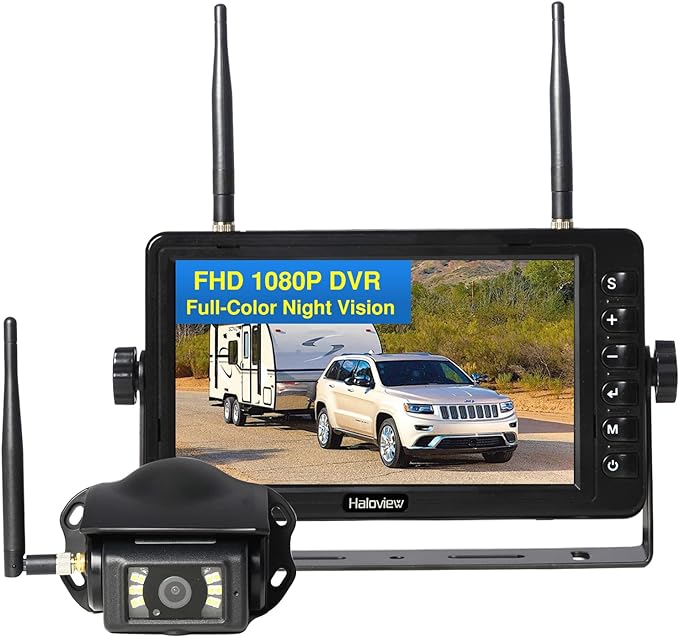

Haloview has become the go-to aftermarket upgrade for RVers who want better image quality than the stock Furrion camera. The BT7 shoots in FHD 1080P and delivers full-color night vision — meaning you see actual colors in low light, not just a green or black-and-white infrared image. That's a genuinely useful difference when backing into a dark campsite or parking area.
What makes the BT7 especially smart for RV owners: it ships with a Furrion adapter so it plugs directly into your existing pre-wired Furrion port. You get all of Haloview's superior specs without any new wiring. The 7" monitor is large and crisp, and the included DVR feature lets you record your drive for insurance or review purposes.
For those who want the most modern interface, the BT7 Touch ($400–$450) upgrades to a 7" touchscreen monitor with 2.4G digital wireless — the smoothest, most lag-free transmission available in this category.
✓ Strengths
- FHD 1080P — noticeably sharper image
- Full-color night vision (no B&W infrared)
- 7" monitor standard on entry model
- DVR recording included
- Furrion adapter included — uses existing port
- IP67 waterproof camera
- 2-year warranty
✗ Weaknesses
- Higher entry price ($300–$350 vs $150–$200)
- Haloview brand less established than Furrion
- Furrion adapter adds one more connector
- Fewer model variants in the lineup
Haloview BT7 Model Lineup
| Model | Monitor | Price | Amazon |
|---|---|---|---|
| BT7 7" FHD | 7" standard | $300–$350 | View → |
| BT7 Touch 7" | 7" touchscreen | $400–$450 | View → |
Our Verdict — Which Brand Should You Buy?
Both brands are solid choices. Your decision comes down to budget vs. image quality, and whether you want the easiest possible setup or the best possible picture.
🟢 Choose Furrion If…
You want the most affordable complete system, your RV is already pre-wired for Furrion (making installation trivial), or you're fine with 720P video and just need basic backup visibility. The Vision S at $150–$200 is hard to beat for the price.
Shop Furrion Vision S →🔵 Choose Haloview If…
You want noticeably better image quality — especially at night. Full-color night vision, FHD 1080P, and a 7" monitor for $50–$100 more than the comparable Furrion S+ makes Haloview the better value at the mid-to-high end. Highly recommended for full-timers and frequent overnight campers.
Shop Haloview BT7 →Frequently Asked Questions
My tow vehicle has a built-in backup camera. Do I still need a separate RV camera?
Yes — your truck or SUV's factory camera only shows the rear of the tow vehicle, not the trailer. As soon as you hitch your trailer, that camera becomes completely useless for backing. A dedicated RV backup camera mounts to the rear of the trailer itself, giving you visibility of the actual end of your rig and everything behind it.
My RV is pre-wired for Furrion. Can I use a Haloview camera instead?
Yes. The Haloview BT7 ships with a Furrion adapter that plugs directly into your RV's existing Furrion pre-wired port. You get all of Haloview's upgraded features (1080P, color night vision, DVR) while still using the convenient wiring your RV already has. No drilling required.
What's the difference between infrared night vision and full-color night vision?
Infrared night vision (used by Furrion) uses IR LEDs to illuminate the scene — you see clearly but everything appears in black and white. Full-color night vision (used by Haloview) uses a more sensitive camera sensor combined with a white LED, producing an image with actual colors in low light. Full-color is easier to interpret and looks more natural, which matters when you're trying to identify a post, a person, or a neighboring rig behind you.
Can I add extra cameras for the sides of my RV?
Both brands support multi-camera setups on select monitor models. The Furrion Vision S+ and some Haloview configurations allow you to connect a side-view camera to the same monitor, switching between views. Check the product listing for your specific monitor model to confirm how many cameras it supports before purchasing additional cameras.
Will the wireless signal hold at highway speed?
Yes — both Furrion and Haloview systems are designed to maintain a stable signal at highway speeds up to about 100 feet. The Haloview BT7 uses 2.4G digital wireless (same band as modern home routers), which tends to be more interference-resistant than older analog wireless systems. If you experience signal dropouts on very long trailers, a signal booster or wired connection may help, though most RVers never encounter this issue with either brand.